
As the Gambia’s largest opposition party, the United Democratic Party (UDP) is set to conclude its ongoing process to select a candidate as flagbearer for the upcoming presidential elections in 2026, all eyes are on the party and who they would unveil as flag bearer. As we write this article, three people have emerged as the shortlisted candidates out of the initial eleven. Former Finance minister Amadou Sanneh, Lawyer Borry Touray and Hon. Ousainou Darboe. Many observers have already concluded that the party’s long time leader, Hon. Ousainou Darboe would be selected yet again for his sixth bid at the presidency.
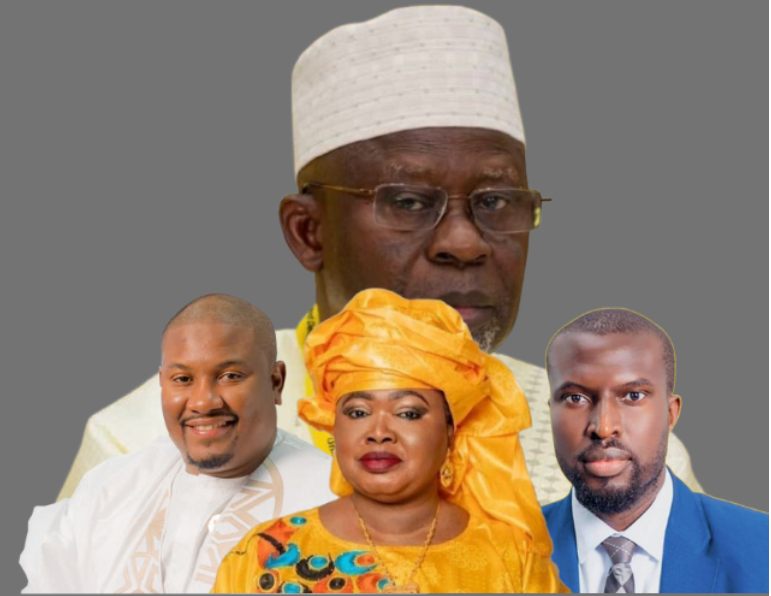
When the announcement was made that the selection process has begun, there was a lot of interest from the onset as many anticipate there will be change and a new face would be unveiled. The popular favorite was Talib Ahmed Bensouda, the 39 year old two term mayor of the Kanifing Municipality. He joined the UDP in 2017 after former tyrant Jammeh was ousted. He ran and won his first bid for elected office as mayor of the second largest municipality in The Gambia. He won a second mandate but announced that would be his last bid in a country that has struggled with self-perpetuating rule since its founding in 1965. A signal that he would be a new kind of leader.
It became increasingly clear that he had ambitions greater than managing a municipality, which he did successfully and with very positive outcomes for the residents of the municipality. His success as mayor was not the only indicator, he was close to the leader of the UDP who many saw as grooming Mr. Bensouda to be his potential replacement.
As National Organizing Secretary of the UDP, his political activities extended to every region of the country. Those skeptical about his end goal started questioning whether these activities were for party interests or a campaign to ultimately serve Mr. Bensouda’s ambitions. As far as the public outlook was concerned, he was loyal to his party and showed deference to its leader Hon. Ousainou Darboe. In fact Mr. Bensouda did state that out of the respect he has for Mr. Darboe, he would not be a challenger if Mr. Darboe sought to be the party’s candidate for the 2026 presidential elections.
That position was not welcome in many quarters within the country, especially amongst political commentators and activists alike, who contended that party founders and leaders, just like the president of the country, should not perpetuate themselves in power and if they do, in the case of political parties, then members within those parties should challenge them to further strengthen the democratic culture. It was with such backdrop that an online campaign started advocating for the selection of Mr. Bensouda as flagbearer for the UDP to challenge incumbent Adama Barrow. However his earlier statement that he would not challenge Hon. Darboe would come back to haunt him when he submitted himself for consideration by the party’s selection committee.
This campaign, that grew increasingly toxic and polarizing between the opposing camps is the catalyst that led to the UDP initiating the flagbearer nomination process much earlier than it traditionally did. The same could be credited for being the catalyst for Mr. Bensouda’s withdrawal from the race.
Know the opponent
There’s a reason why governments and countries spend billions of dollars and send countless citizens into enemy territory for intelligence gathering. Understanding your enemy and how he thinks and operates and then strategizing along those lines is key in deciding the outcome of any potential battle/military confrontation. In politics, its called opposition research.
Although all contenders for the flagbearer position in the UDP are members of the same party, the desire for the position created rivalries and such rivals, albeit temporarily, should be treated as opponents to enable one to better position oneself as a better alternative. All of these fit within the party’s wider culture as determined by institutional culture, but more importantly how its members and supporters think and operate. Understanding that is foremost on the agenda for any contender who seeks to lead the party. And this is where the fatal blow to Talib Bensouda’s ambition was dealt, not by him necessarily, but those advocating for his elevation to the party’s ticket.
Nothing happens in a vacuum. There are sensitivities within the UDP that have been cultivated in the party’s decades long struggle against Jammeh’s tyranny that cannot be ignored but are often trivialized in our toxic political space. Whenever these sensitivities are triggered, there’ll ALWAYS be a reaction from UDP supporters and members. Some may see it as an overreaction or extreme, both of which do in fact happen, but unless the underlying triggers and how certain statements and/or actions are interpreted in relation to those triggers, there will always be backlash.
When dealing with human emotions, trying to rationalize actions emanating from triggered emotions or trying to draw logical conclusions is a futile endeavor. Our job is not to even make sense of it, we just have to understand the trigger, acknowledge it and like a skillful strategist, deftly navigate our way around issues that could trigger such sensitivities.
For the UDP there are are few, but two rank highest, ignore them in your dealings with the party and its militants and you’ll trigger a backlash and you better have endurance for what is to follow.
1. Loyalty. I know you are already thinking that is irrational and cult like. Remember the first rule, it does not have to make sense to YOU. Darboe basically embodies UDP, he is revered within UDP mainly for his loyalty to his supporters and commitment to the party. The party supporters and militants reciprocate that loyalty and stand guard in defense of his honor. You can criticize him, even that is sometimes frowned upon but the worst reaction you will get in that scenario is some irrational justification for the action he is being criticized for, nothing more. As long as the criticism is not delivered in a way perceived as being disrespectful.
Again, this may seem irrational or “cult-like” as some would brand it, but it is the truth. If you do not respect that in your dealings with UDP and approach it with a “hanaa Darboe moi kan” (who is he not be criticized), you are potentially looking at Hillary Clinton’s “basket of deplorables” fallout situation. You have to decide, do I want to trigger the base, or do I want results. That decision is entirely yours to make and the reaction you get would be determined by it.
2. Post trauma wariness. UDP endured a lot under Jammeh. Despite their relentless commitment to their course, there has been a lot of hurt and some still carry that hurt within. Despite all the sacrifice, when relief was finally within grasp, their hopes were betrayed only for them to watch people who stood in their way, ridiculing them at every turn and mocking their efforts benefit off of their labor with a in-your-face disdain for anything UDP, including personalities within. Offering some historical context is relevant here.
Poor rural folk carried PPP to power at the dawn of The Gambia’s independence, the need to tap into the limited pool of educated folks forced the first President Sir Dawda Jawara to turn to the colony folk, who, thanks to colonial policy were the ones who had access to western education, a needed commodity for having a role in state institutions. That was a huge let down for the people who were in the trenches, but thanks to that policy were left out of the education system and therefore ill-equipped for any meaningful role in the new dispensation. From their perspective, they felt used and dumped as they saw cronyism, nepotism, and rampant corruption take root and as a result elevate a certain segment of society while they wallow in continuous poverty.
We had a similar mindset in 2017 when Barrow was asked if he would hire APRC folks. because the general feeling was that as enablers of and beneficiaries of tyranny while the rest mourned and suffered, they should not be a part of the change. In fact there were proposals for banning the APRC.
Barrow eventually would not only hire APRC folks, he literally became APRC. If you wonder why Seedy Njie is so hated, show me where he lifted a finger pre 2017 to help Barrow. Today he’s the most powerful person in the country after Barrow when Barrow would not even name Nogoi Njie by name after she succumbed to the effects of torture that Jammeh’s thugs inflicted on her.
There is a strong degree of resistance to what we call the “monkey work, baboon eat” syndrome.
Of course one can rationalize all these and conveniently find a suitable candidate to heap the blame on, that does not necessarily translate to acceptance by the people who see it as an unjust reality.
If you don’t understand these dynamics, or you choose to ignore them, then you will fall into the trap of misdiagnosing the issue thereby creating a whole new problem. And this is where the problem started for Talib Bensouda’s candidacy, not by him specifically, but by some of his self-assigned surrogates.
This misdiagnosis is what leads some to conclude that segments within the UDP have a sense of entitlement or are driven by tribalism. It may appear so, but it is deeper than that.
“What makes Talib so special that he should be handed the mantle without contest? We will not be the ones who get beat, jailed and killed or watch the same happen to our parents and loved ones only for people who condemned us every step of the way, made fun of our suffering and ridiculed our efforts to become the beneficiaries of the change we fought for by aligning themselves with people in positions of power while we get cast to the wayside, labeled and ridiculed by those same individuals with the complicity of people in our midst. If us resisting such insulting conduct makes us tribalists, then so be it.”
A UDP Supporter
Again, cast it aside as baseless paranoia, but history would not be on the side of that claim. This is the underlying issue for some within the UDP that are opposed to Talib’s candidature.
When he was elected and given the mandate to nominate people to the council, two prominent figures nominated were Neneh Freda Gomez, formerly of Citizens’ Alliance (CA) and MC Cham Junior formerly of Gambia Democratic Congress (GDC). Both of these people are passionate advocates for a better Gambia and fearless in their advocacy, likeable and competent. But in a country where such appointments are seen as pathways that empower people by raising their profiles and granting them access, it gets interpreted differently.
Compare that to Yankuba Darboe, another popular favorite for leadership of the UDP. When he was elected Chairman of the largest region of the country, he nominated people who were prominent UDP supporters. One of them, the nomination of Binta Senghore caused an uproar and he stood by her until she was confirmed. Revisiting that episode will tell you all you need to know about this dynamic. It is not tribalism and labeling it thus will not change the underlying feelings.
Those sensitivities were triggered when the social media campaign to make Talib the flagbearer made no reference to the selection process, rather started off by calling for “MAKING Talib the flagbearer” of UDP. That was responded to with a query; “what about the other people within the UDP that also want the position and have been in the party longer and suffered the indignities of Jammeh’s abuse?”
The second argument in favor of Talib’s candidature was to claim that putting a Mandinka on the ticket would spell certain defeat for the UDP. This was not just infuriating, it was especially insulting. Before his defeat, Jammeh swore that a Mandinka will never occupy the seat of presidency in The Gambia. Despite the fact that they constitute the largest ethnic group in the country, Jammeh effectively engineered a tyranny of the minority against the majority group and what we often refer to as tribalism is in fact anti-Mandinka bigotry. Reechoing such sentiments will certainly be met with backlash. Reactions such as asking; “when will the Gambia be ready for a Mandinka president then? Why must it be a non-Mandinka?”
Maybe the instigators of such arguments meant well, but the way the argument was presented fell far too short of considerate public discourse and the reactions it generated led to the fallout we are witnessing.
Arguing that Mr. Darboe has tried nearly a half dozen times to get elected without success, that a new candidate may fare better is a fair argument, and should be presented for debate in a respectful approach.
Talib ran two successful bids to be mayor of the second largest municipality and did so with the support of people who traditionally do not support a UDP candidates is a good selling point as well. That too should be presented for debate without casting other contenders as less than or ill-fitted.
But what we saw was presenting that argument by labeling Darboe as greedy while presenting Talib as an electable non-Mandinka alternative. That obviously is a terrible sales pitch. The end result is what we are all witnessing, an unnecessary and unwinnable contest between the loyal supporters of a revered veteran and those of a charismatic up and coming young leader. One side labelling the other side’s candidate as greedy, power hungry, unelectable and his supporters as cult members. They respond by labeling the opposite side’s choice as scheming against the party and people who raised his profile, as being manipulative, underhanded and disloyal for personal gain.
Who wins in that contest? No one. That’s who!
What Talib does after his withdrawal from the race for UDP flagbearer and resignation as the Party’s Organizing Secretary is left to him and yet to be determined. But should he go solo, what do you think will be the campaign rhetoric against him, especially within Mandinka communities whose voters he needs while his supporters vilify the same Mandinka as tribalists? That die has already been cast.
UDP may as well select Darboe again as its flagbearer and see if their luck changes this time around, but those who left UDP in protest against Talib’s ouster would become tools to damage any chances UDP has. The status quo remains as we all wallow in misery only to manufacture another crisis at the end of the next term.
This is why moderation is key in every interaction. Don’t burn your bridges behind you, you may need to journey back.
Whatever the future holds, we as a people need to understand our unique contexts. Although we may not agree on most things, but understanding each other’s convictions, motivations, and sensitivities is a necessity if we are to shape a democratic space that is rooted in civil discourse as opposed to the current rage-fueled arguments we witness around every subject, from culture, to religion and certainly politics.
When a people are given an opportunity to shape their own destiny and show that they are incapable, their fate gets decided for them by others who will neither seek their approval, nor respect their inputs or heed their protestations. We had a taste of that under Jammeh. The next will be worse.

 Mankajang
1 thought on “The UDP flagbearer – When reverence and loyalty clash with popularity and ambition”