Incident after incident, the police have shown their willingness to tow the political line thrown out by the State House, who by the way, still insists that the lone suspect recently acquitted by the courts is guilty and claims that the courts failed at delivering justice despite the obvious lack of evidence following a two year trial. Testament to that lack of trust in the state’s positions, citizens are still asking the unanswered question, WHO KILLED THE COPS.
There are many claims and theories being made on the detention of Kemeseng Sanneh (Kexx as he is popularly known). The police announced on their Facebook page on April 11, 2026, that they have Kexx “in custody” as they investigate an “alleged sexual offence involving a minor.”
Latest news indicate that the alleged offender has been granted bail. We will not attempt to into the various claims, as credible as some of them seem. That is not the topic of this post.
The question that can be asked, however, is what gave rise to the various theories and claims currently being made. All of them have one thing in common. They point to motives other than genuine law enforcement. True or false, the fact of the matter is that the Gambian public overwhelmingly do not trust The Gambia Police Force under its current leadership. The credit for that goes to their own conduct and record. Case in point is their rush to politicize the unprovoked murder of two young police officers and the attempted murder of a third in the same incident.
In my most recent post, I laid out the case for how political survival is undermining the rule of law in The Gambia and gave examples of the various instances of how political maneuverings led to unmet expectations and unfulfilled promises.
All this incompetence is by design. Subdue the people and institutions you can, either through favoritism, bribes, or nepotism, and attack and intimidate those you cannot. The first strategy of bending institutions to the political will of the chief executive works with state institutions. The strategy of attacking or intimidating those who do not bend the knee is applied to those outside of executive control, opposition political parties, civil rights activists, journalists, and then judicial officers.
You see, members of the Judiciary, at least at its highest levels, are not subject to presidential censorship, where the president can wake up and fire them at will. They are part of a coequal branch of government. At least that is the case as long as a semblance of democracy remains. The National Assembly is a coequal branch too, by constitutional design, but look at where they stand on public interest versus the political interest of the few, including the president. The last to fall in this sequence is always the courts. When that happens, we are entirely in a tyrannical state where the president is effectively a king, answerable only to his desires. And that is the goal. Do not, for a second, think this is alarmist or that it is too farfetched to even consider as a possibility. It is on the fast approach to becoming reality.
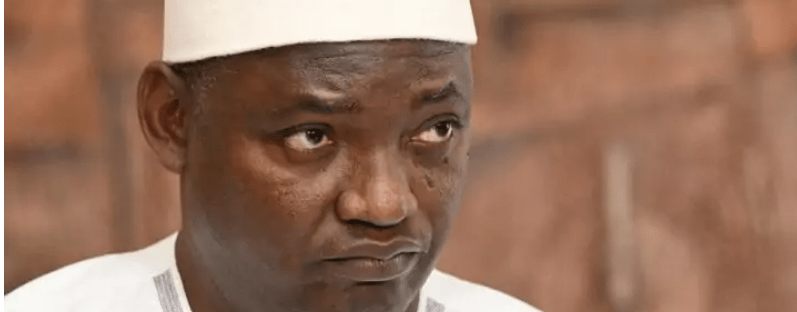
Everything we are witnessing and being put through, is designed to give Barrow those kingly powers he so desperately craves. Remember when he referenced himself as Nghaleng Sonko? That is the point. Barrow’s primitive perception of what power is supposed to look like is completely anathema to modern concepts of governance, and he will not stop seeking that goal until we, the people, stop him.
You can claim things are better under Barrow than they were under Jammeh. Or pretend that Barrow has no agency, that all of this is someone else’s fault, but the trajectory is clear, the death of democracy in The Gambia is the final outcome. And we are closer than you think. Barrow is in his ninth year in power, let us go back and see where Jammeh was in his ninth year in power, shall we?
Jammeh’s ninth year in power would be 2003. His relationship with opposition figures is no secret and started soon after he assumed power in a coup. Jammeh attacked opposition parties, assaulted their supporters, killing some. Barrow has not done so yet, but who in their right mind will say Barrow is on good terms with those opposed to his politics or administration. He is so antagonistic to the opposition, especially UDP, that he encouraged his supporters to essentially attack his political opponents, asking them what they were afraid of since they are members of the party in power. Remember Jammeh’s Green Boys and their relationship with UDP? In fact, many believe that the murdered police officers were victims of a hire to kill political hit job. Assassininate state employees and blame it on the opposition. True or false, the rush to put out a narrative before any evidence was presented gives space for that viewpoint.
The attempt to contain opposition voices through intimidation is already in full gear. So too is the case with civil society. Jammeh’s most egregious crime happened in April 2000 when he murdered over a dozen school children. He was less than five years in office then. That massacre was his response to peaqceful protest. Remember the response to the Three Years Jotna protest two years into Barrow’s term?
By Jammeh’s ninth year, there was no arson attack on Ebrima Sillah’s home yet (August 2004) – Yes, the same Ebrima Sillah who is now minister. In the same period, then president of the GPU D.A Jawo was reported to be receiving threatening letters from anonymous sources threatening to “teach one of your (GPU) journalists a very good lesson soon.” Deyda Hydara was still alive then (murdered in December 2004), There was no arson attack on The Independent Newspaper premises yet (October 2003). The “Junglers” were not around, at least not in the form we came to know them (formed around 2003 – 2004). I cite thes to say there was still a degree of journalistic independence and editorial stance that was critical of the government. As is still the case with Barrow.
But look at Barrow’s current relationship with media houses and journalists who do not sing his praises. He bribed those he can, shut GRTS off to critical voices, formed his own propaganda outlets, and those he cannot buy off, he tried through PURA to shut them down. That pathway did not work. What is he going to try next? Because he is not done yet.
Now, let us look at the judiciary and compare that to the tactics under Jammeh, shall we? Remember this from Hamat Bah:
Everybody who comes there [the courts], there is a judgment against the State. Every issue, there is an injunction against the State as if the State is your enemy. If you know the amount of judgment they took against this Government, if we were to pay, next year there will be no budget. Let those making decisions in institutions, courts and everywhere understand that the State belongs to all of us. When it is Adama Barrow or the Government, “Pam” and you don’t like anything [about] the Government, “Pam.” That has to end. – Foroyaa
Now, compare that to Jammeh. Much later in his term, in 2014, he swore in a new Chief Justice, Ali Nawaz, a Pakistani national. In that swearing in ceremony, Jammeh said the following:
I just want you to understand that there is nowhere in the world where the judiciary is independent. We pay your salary, we appoint you, and you are part of the government – how can you be independent? – Read how the law was weaponized to this point in this piece by Justiceinfo
You see, if the courts are not doing the bidding of an authoritarian wannabe, because courts judge on evidence, and the authoritarian’s perceived enemies are law abiding, it is hard to silence them through the courts. That is when desperate measures enter the mix. The kind that lies outside of the law.
Jammeh manipulated the 1997 constitution to give himself power over all three branches of government, hence the emergence of mercenary judges in The Gambia. You judge in favor of the state (read Jammeh) or get fired.
If you are asking, but you need the National Assembly to pass laws before that can happen. Well, he had a strategy for control over the NA by sidelining regions that vote against him and his party’s candidates, forcing everyone (almost) to vote for APRC and whoever the party presents as a candidate. This is how he gets a super majority in the House.
But what about their duties to the people who voted for them and the interests of their constituents? He had a solution for that too. If you are fired from the party on whose ticket you got elected, you lose your seat. Those elected officials serve at Jammeh’s pleasure. Disobey him, he fires you from APRC and you lose your seat. By-election comes, same intimidation tactic.
Remember Barrow’s condemnation of regions that vote for UDP, especially in Kiang? Remember Ya Kumba’s Jaiteh’s “firing” from the National Assembly? How about the open obstruction of a people centered constitution from passing through the National Assembly?
We have been here before. The alarm bells were sounded on Jammeh too. But those who benefitted from the system always had a counter narrative until the tide turned and they jumped ship. They are now on the Barrow life raft and are doing exactly the same narrative countering as the political prostitutes they are. Just like those who work the actual profession in real life, they are only after the reward. They are paid to play agents, yours until the next paying client comes along and you become yesterday’s story.
When institutions are subdued, and the voices of dissent are silenced, the nation is at risk. One voice still remains though, register to vote and vote out these charlatans to stop the impending authoritarianism.

 Mankajang